Canadian 2025 wildfire smoke over Norway and Europe
The 2025 fire season from Sentinel-3 and Sentinel-5P aerosol products, with focus on aerosol layer height, compared with FLEXPART black-carbon transport and EarthCARE lidar profiles.
Home / Projects
Exploitation of ongoing and future COpernicus Missions for Atmospheric aPplications, Phase 2
Technical development for Norwegian national services based on Copernicus satellite data: new value-added products for science and society from Sentinel aerosol data, the first Sentinel-4 observations and preparations for the LSTM thermal mission, and further development of the web services established in ECOMAP.
The 2025 fire season from Sentinel-3 and Sentinel-5P aerosol products, with focus on aerosol layer height, compared with FLEXPART black-carbon transport and EarthCARE lidar profiles.
Trends and seasonality from about ten years of Sentinel aerosol data over mainland Norway and Svalbard, compared with ground-based observations at Birkenes and Ny-Ålesund.
Hourly Sentinel-4 NO₂ over the cities of southern Norway compared with the daily cycle at ground monitoring stations.
Hourly aerosol and CO observations from Sentinel-4 to follow wildfire smoke and dust plumes reaching the Nordic countries.
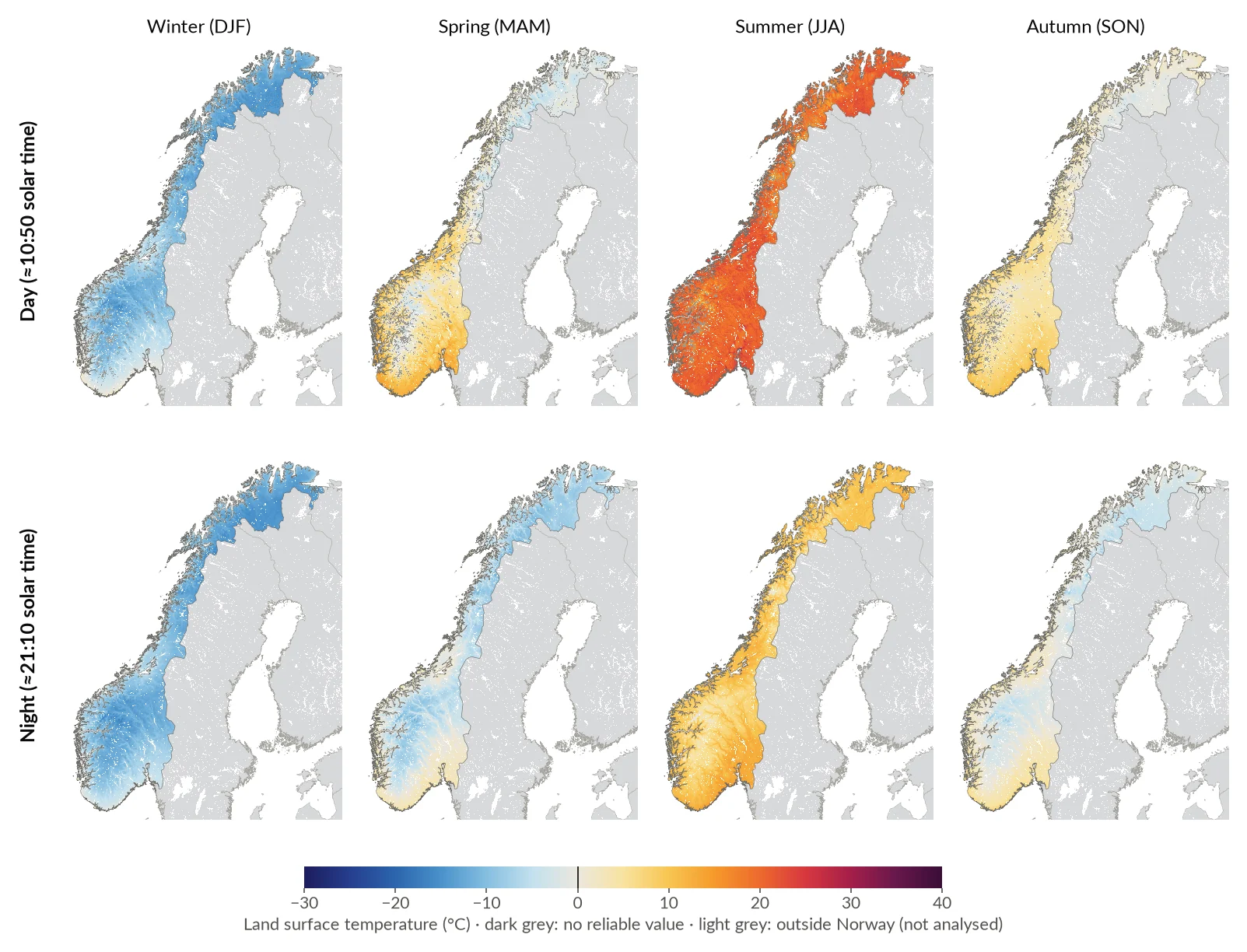
Daily 1 km Level-3 LST from Sentinel-3 SLSTR for 2020–2025, with monthly products, quality levels and a climatology for Norway.
100 m LST from Landsat thermal data for Norwegian towns as a stand-in for the future LSTM mission, with urban heat island maps and a consistency check against Sentinel-3.
Automated processing chains; for LST about 247 000 Sentinel-3 products (≈ 20 TB) downloaded and gridded so far.
New value-added maps in the Arctic Atmospheric Data Viewer, the Norwegian LST Explorer and this project website.
The complete Sentinel-3 LST archive for 2020–2025 (about 247 000 products) has been processed into daily 1 km maps, monthly products with quality levels and a climatology for Norway, including the surface urban heat islands of 44 towns. The results are available in the Norwegian LST Explorer.
| 2026 | 2027 | |||||||
|---|---|---|---|---|---|---|---|---|
| Q1 | Q2 | Q3 | Q4 | Q1 | Q2 | Q3 | Q4 | |
| Aerosols | ||||||||
| Canadian 2025 wildfire smoke | Report | |||||||
| Aerosol climatology for Norway | Report | |||||||
| Sentinel-4 | ||||||||
| Daily NO₂ cycle | Report | |||||||
| Transboundary plumes | Report | |||||||
| Land surface temperature | ||||||||
| LST reference baseline | Report | |||||||
| High-resolution LST proxy | Report | |||||||
| Data & web | ||||||||
| Data acquisition & processing | ||||||||
| Web dissemination | Website | Update | ||||||
Dark cells mark when results are reported: mid-term report in December 2026, final report in December 2027; this website in December 2026, updated in December 2027.
Results will be presented at institute seminars and conferences (e.g. ESA’s Atmospheric Science Conference, EGU), and at least one peer-reviewed publication is planned. A seminar with the Norwegian Environment Agency, the Norwegian Directorate of Health, municipalities and other stakeholders will discuss how the outcomes can best serve society.